martes, 20 de marzo de 2012

The 13th Warrior

After the introductory powerpoint you will see the USA film "The Thirteenh Warrior" , which is based on Michael Crichton's pseudo-historical novel Eaters of the Dead. In order to revise the different topics you have learned about in class for the last weeks you are asked to answer the following questions while watching the film.

-Where and when is the action set?
-Can you see any social hierarchy in the groups depicted in this film?
-Compare the Arab and the Viking government system.

-Which evidence have you found in the film to prove that Vikings were superstitious?
-How does Ahmed learn the language spoken by the Norsemen? Which language is this?
 -Can the Norsemen in this film read or write? Why do you know?
-Which enemy does the group of Vikings have to fight against?
-Do you think that this film is entirely historical? Why?


Voluntary task.
Do a portfolio about the historical background and the legend of Beowulf to hand in on the last day before Easter holiday.

domingo, 18 de marzo de 2012

Romantics turned into nationalists: Verdi and the claim for freedom

Many of Verdi's operas can be interpreted as allegories for the Italian struggle against the Austrians and other foreign oppressors. The most famous is Nabucco (1842), about the captivity of the Jews in Babylon. Its chorus of the Hebrew slaves, 'Va Pensiero', became virtually the anthem of the national movement.

Exercises about the Italian and the German Unifications

Italian Unification

-Which Italian kingdom played a leading role in the unification process?
-When did the Italian unification process finish? (year)
-How many phases in this process would you establish after looking at the map?
-Which European nation had a pre-eminent position in the Italian peninsula at the beginning of the 19th century?
-Were other nations involved in this process? Which and how?
-Which Italian characters participated in the unification in one way or another? If possible, would you be able to say where they came from?
-Was there any other non Italian character's participation in these events? Who?
-Were there any revolutions in the Italian peninsula in 1848-9? Where? Did they have any success?
-Why did the French army intervene in Rome in 1849?
-When and how did the Italians add the kingdom of Lombardy?
-Who were responsible for the “conquest” of territories in 1860? How?
-Who was declared the king of Italy?
-When and how did the Italian side obtain Venetia?
-What was the last territory to be added to the Italian Kingdom? When was it incorporated? How?
-Look for information about the ideological differences between Garibaldi, Cavour, Mazzini and Victor Emmanuel II. Would you be able to classify these four characters into two main government options for the newborn Italian nation?

German Unification

-Who was Metternich?
-Which territories did Prussia control in 1815, after the Congress of Vienna?
-Was there any freedom of expression in the German states? Why?
-What was the Zollverein? Did it have any precedent? Why do you think that Austria wasn't allowed to participate by Prussia?
-Which consequences did Metternich's resignation have in 1848?
-What did the Frankfurt Parliament consist of? Did it have any success? Why?
-What was the main aim of the Erfurt Union? Did it have any success?
-What happened in Prussia during 1860-62?
-Were Schleswig and Holstein important in the relationship between Prussia and Austria? Why?
-Which nation added these Danish duchies finally? When were these territories incorporated? (look at the map)
-In 1867 the German states were divided into tho main areas of influence. Which?
-Read the information about the Hohenzollern crisis. Do you think that Bismark acted in a cunning way with regard to this issue? Why?
-If I say that Bismark promoted the nationalist feeling in 1870... what do you understand?
-Which were the last territories to be incorporated to the German Empire (Second Reich) led by Prussia? When were these added?
-When was the Franco-Prussian war fought? How did it end? Which territories were given to the winner?

domingo, 26 de febrero de 2012

The revolutionary 19th century


Revolutionary Europe (1820-1848)

The Congress System broke up because France and Britain were in total disagreement with Russia, Austria and Prussia. After 1815 the great powers never met again.
Nationalism, liberalism and socialism became the major influences which help us to understand the revolutionary processes along the period which started in 1820.

Liberal and nationalist revolutions of 1820
In 1820 the first liberal revolution broke out in Spain. The liberals rebelled, under the initiative of a general called Rafael Riego, and managed to force the absolute king, Fernando VII, who had rejected the liberal constitution which had been previously passed in 1812, to accept the popular sovereignty which was represented by this former legal document. For three years the liberals governed Spain, until French troops intervened militarly in 1823 making the revolution to fail. 
                                               Rafael Riego, a liberal general
Shortly after the Spanish revolution, a liberal revolution in Portugal succeeded and a constitutional government was created. This wouldn't have been possible without an army the British sent in order to make sure that the revolt had success.
In Latin America the subjects of the kings of Spain and Portugal rebelled in order to obtain their independence. Spanish colonies were lost in Latin America, with the exception of Cuba and Puerto Rico.
The members of the Holy Alliance tried to intervene but they met the hostility by the British and the USA president, James Monroe, who declared, in his famous Doctrine of 1823, that any interference by European powers in the affairs of the American continent would be regarded "as the manifestation of an unfriendly disposition to the United States"; in other words, an act of war.     
The last revolution of the decade was the Greek. These people rebelled against the Ottoman Turks. For several years the Greeks had been fighting for their independence from the Ottoman Empire, and finally they obtained it in 1827, thanks to the support of different nations: France, Britain and Russia. In 1832 the European major nations recognized Greece as an independent sovereign state.
                                                                   Siege of the city Messolonghi, symbol of the Greek resistance
Revolutions of 1830
In France the population revolted against the absolute Bourbon monarch, Charles X who had published four ordinances dissolving the Chamber of Deputies, suspended freedom of the press, modified the electoral laws so that three-fourths of the electorate lost their votes, and called for new elections to the Chamber in September. Strikes and protests were followed by armed confrontations. The royal forces were unable to contain the insurrection and, after three days of fighting (July 27–29) Charles X was replaced by another king, Louis-Philippe d'Orléans, who had fought for the French Republic in 1792.
The French example was followed in many parts of Europe in the same year but most liberals throughout Europe were disappointed in their expectations of a radical, social change since the other revolts were supressed harshly.
In Poland, people revolted against the Russian Tsar, but their revolt was cruelly suppressed and Poland was incorporated into the Russian Empire.
Belgium declared its independence from the Netherlands, and it was recognized in 1831 as an independent nation.
The Italian and German nationalist and liberal revolts were cruelly ended.

Revolutions of 1848
This year was known as the Spring of Nations or the Year of the Revolution.
The period of unrest began in France and then, further propelled by the French Revolution of 1848, soon spread to the rest of Europe.
In Paris middle class elements demanding the vote were joined by workers demanding an end to their explotation. King Louis Philippe fled into the exile and his constitutional monarchy was substituted by the French Second Republic. This government was headed by Louis-Napoleon who, after only four years, returned France to a monarchy with the establishment of the Second French Empire in 1852.
The French was the only revolution in 1848 which was successful.
                                                      Le Cri du Peuple (comic by French artist Tardi about this revolution)

Other revolutions: 
a) Liberal (Vienna)
b) Nationalist (Hungary, Bohemia, North of Italy, German states)

The years 1815 to 1848 have often been called "the years of Metternich". Klemens von Metternich was the Austrian chancellor at this period and he was, without doubt, the greatest statesman in Europe. His ambition had been to destroy all traces of revolutionary change in Europe introduced since 1789. He was the arch-conservative who was violently opposed to any kind of reform and who succeeded in imposing his ideas on the rest of Europe, helped by the Holy Alliance.
He realised that if the liberal and nationalist demands were met, and the people of Europe were given the chance to freely choose the country in which they lived and the type of government that ruled them, then the Austrian Empire was finished. Until 1848, he had largely succeeded, but, in that year, when Hungary had risen in revolt and Austrian students had demonstrated in the streets of Vienna demanding "Down with Metternich!", the emperor dismissed him.


Activities:

1) Why do you think that France crushed the first Spanish liberal revolution in 1823?

2) Comment on the following quote by the USA President, James Monroe:
The American continents ... are henceforth not to be considered as subjects for future colonization by any European powers.

3) Comment on the following quote by Von Metternich:
Italy is only a geographical expression

4) Why did the French, who already had a constitutional monarchy, rebel, in 1848, against their monarch, who, besides, had defended the revolutionary principles actively in 1792?

Extra, voluntary task:

1) Write a composition (250 words) on the Latin American Revolutions and the role Simon Bolivar adopted in these.

martes, 14 de febrero de 2012

Changes in the blog

As technical problems didn't allow you to download some of the materials I've been uploading up to now I have decided to do it in a different way.
Since now, if you are interested in downloading some of the resources we are using in class, you will have to go to the right side of the blog, below the List of resources section and look for your topic. Once you have found it, double-click on it. You'll be redirected to another page where you can directly download the file as a pdf.
I'm uploading past documents during this week. So if you can't find an old one, please be patient.
If you have any problem let me know.

Let's go back to the past: The European Restoration

I. The Congress of Vienna (1814-15)

After Napoleon's abdication in April 1814, representatives of all the states of Europe met in Vienna in order to decide what to do now that the Napoleonic threat had disappeared.
They had three priorities:

-To reduce the size of France to its frontiers before Napoleon's invasion.
-To ensure that France could never again be a threat to the rest of Europe.
-To recompense those countries that had been “anti-Napoleon” and punish those that had been “pro-Napoleon”.

The attendants to this meeting in Vienna were:

a) Austria, Prussia, Russia and Britain (the most important)
b) France, Spain, Portugal and Sweden
c) Bavaria, Hanover, Denmark and Savoy (minor states)

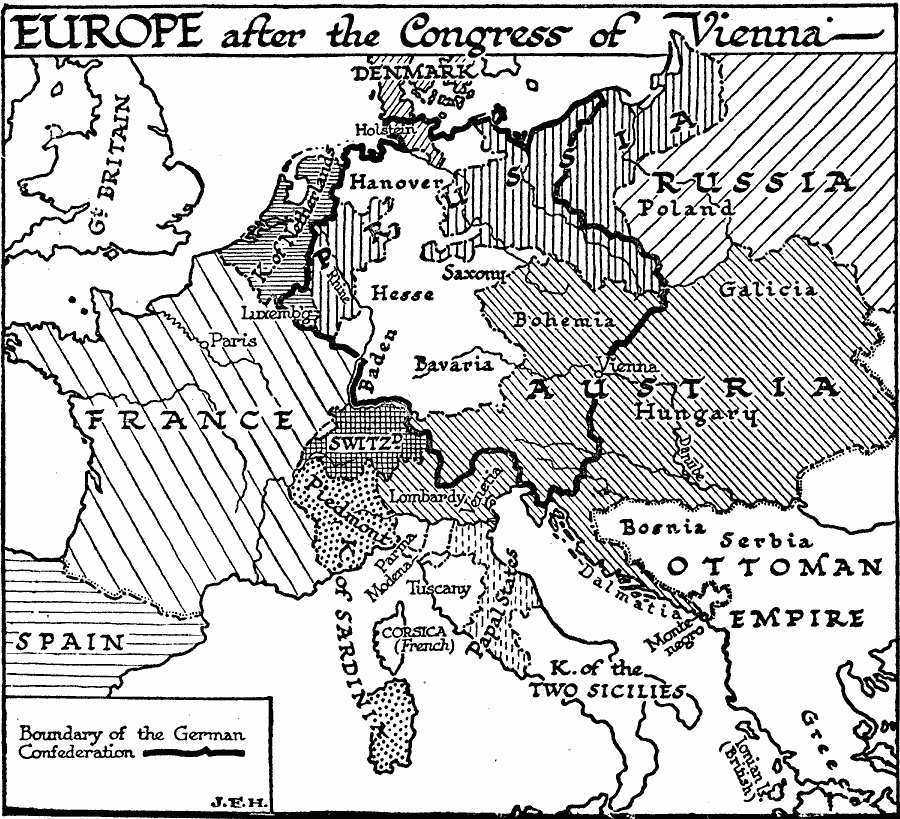
The map of Europe was modified after the Congress in this way (click on these words to enlarge the map below):


There is another map (in colour and clearer) of the territorial distribution after Congress of Vienna on the following link you can also use.

Major failings of the Congress of Vienna were:

a) The redrawing of the map of Europe took no account of the wishes of the ordinary people, with regard to the nationalist feeling which had appeared during the Napoleonic military campaigns and had been fatal to him. Millions of people in Europe refused to accept the imposition of foreign rulers and, as a result, nationalist revolutions broke out in many regions after 1820.
b) After the dismantling of Napoleon's empire, Russia, Austria and Prussia wanted to reinstall monarchies of the Ancien Régime. This led to more revolts and revolutions since Napoleon had introduced liberal constitutions which made a profound impact on the people who lived in the regions the French Emperor had conquered.

II. The Holly Alliance

It was a coalition of different states which was created in 1815 and whose members were Russia, Austria and Prussia .The monarchs of these three nations wanted to install the Christian values of charity and peace in European political life, but in practice what they were chasing was to band together in order to prevent revolutionary influence (especially from the French Revolution) from entering their territories. Except for Great Britain, the Vatican and the Ottoman Empire, all other European nations joined.

Activities:
  1. Which type of government did the founders of the Holly Alliance have? Why didn't Great Britain join forces with these nations?
  2. Remember what we have seen in class about liberalism. Describe the political and economical features this term had at the time you are studying. Did the Enlightenment have any influence on liberalism? Why? 
     
  3. Compare the 1812 map and the map for the period after the Congress of Vienna. Which changes can you observe? 
     
  4. What's the model for the liberal constitutions Napoleon introduced? 
     
  5. Comment on the following sentence from a History textbook :
    The European Restoration meant an ideological conflict whose consequences echoed throughout the nineteenth century (...)”.
           Focus on these concepts: European Restoration, ideological conflict and consequences

martes, 7 de febrero de 2012

Extra sources about Napoleon

Napoleon (2002)


French-German-British mini-series about Napoleon's figure.

Master and Commander: The Far Side of the World (2003)


Film based on author Patrick O'Brian's series of naval books whose action is set during the Napoleonic Wars, at the beginning of the 19th century. A good adventure film as well as a historical drama which was nominated to 10 Oscars.

War and Peace (1956)


Classical drama film based on Leo Tolstoy famous novel which illustrates the war between the French and the Russian Empires.

Barry Lyndon (1975)


Film which tell us about the adventures and misadventures of a member of the minor, landed aristocracy of Ireland who wants to climb the social ladder and reach a higher position by means of enrolling in the British army. Subsequently this fact will lead him to participate in the Napoleonic Wars. 
The film was produced, written and directed by famous director Stanley Kubrick and it is considered one of his finest works.

The Duellists (1977)


Historical drama film which is set during the Napoleonic Wars and whose plot is about two French Hussar officers's feud, whose cause is a misundertanding between both duellists, is  over fifteen(!) years. It was the first film Ridley Scott directed. As an anecdote I'd say that this film contains real fencing scenes, something which is not usual in most later films.