Mostrando entradas con la etiqueta Activities. Mostrar todas las entradas

martes, 20 de marzo de 2012

The 13th Warrior

After the introductory powerpoint you will see the USA film "The Thirteenh Warrior" , which is based on Michael Crichton's pseudo-historical novel Eaters of the Dead. In order to revise the different topics you have learned about in class for the last weeks you are asked to answer the following questions while watching the film.

-Where and when is the action set?
-Can you see any social hierarchy in the groups depicted in this film?
-Compare the Arab and the Viking government system.

-Which evidence have you found in the film to prove that Vikings were superstitious?
-How does Ahmed learn the language spoken by the Norsemen? Which language is this?
 -Can the Norsemen in this film read or write? Why do you know?
-Which enemy does the group of Vikings have to fight against?
-Do you think that this film is entirely historical? Why?


Voluntary task.
Do a portfolio about the historical background and the legend of Beowulf to hand in on the last day before Easter holiday.

domingo, 18 de marzo de 2012

Exercises about the Italian and the German Unifications

Italian Unification

-Which Italian kingdom played a leading role in the unification process?
-When did the Italian unification process finish? (year)
-How many phases in this process would you establish after looking at the map?
-Which European nation had a pre-eminent position in the Italian peninsula at the beginning of the 19th century?
-Were other nations involved in this process? Which and how?
-Which Italian characters participated in the unification in one way or another? If possible, would you be able to say where they came from?
-Was there any other non Italian character's participation in these events? Who?
-Were there any revolutions in the Italian peninsula in 1848-9? Where? Did they have any success?
-Why did the French army intervene in Rome in 1849?
-When and how did the Italians add the kingdom of Lombardy?
-Who were responsible for the “conquest” of territories in 1860? How?
-Who was declared the king of Italy?
-When and how did the Italian side obtain Venetia?
-What was the last territory to be added to the Italian Kingdom? When was it incorporated? How?
-Look for information about the ideological differences between Garibaldi, Cavour, Mazzini and Victor Emmanuel II. Would you be able to classify these four characters into two main government options for the newborn Italian nation?

German Unification

-Who was Metternich?
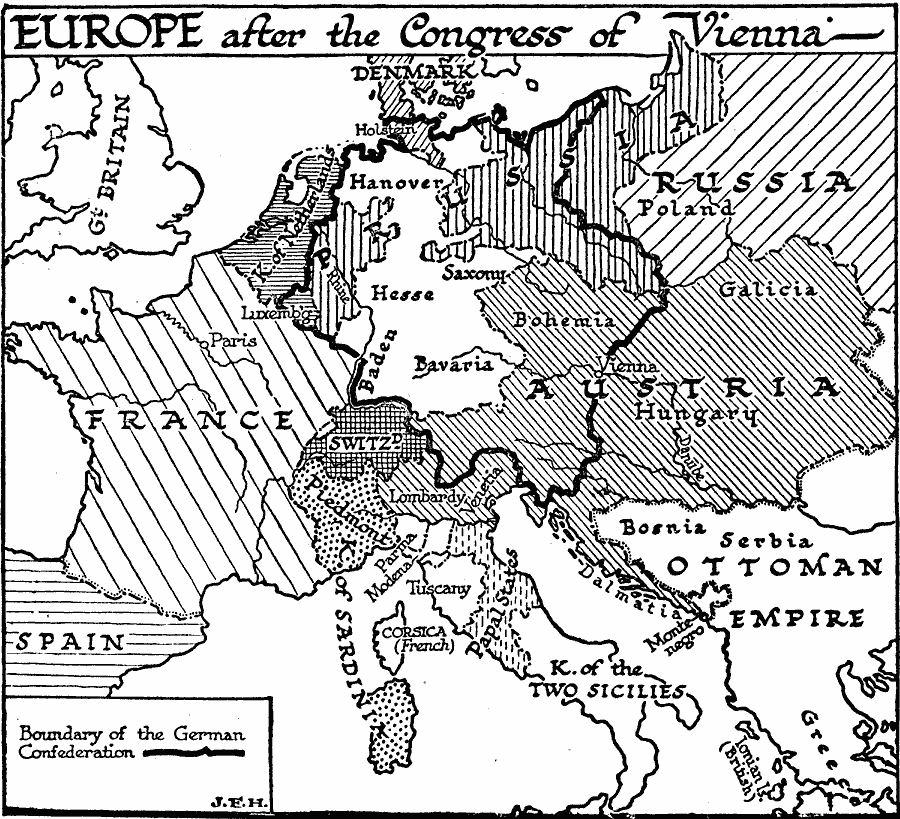
-Which territories did Prussia control in 1815, after the Congress of Vienna?
-Was there any freedom of expression in the German states? Why?
-What was the Zollverein? Did it have any precedent? Why do you think that Austria wasn't allowed to participate by Prussia?
-Which consequences did Metternich's resignation have in 1848?
-What did the Frankfurt Parliament consist of? Did it have any success? Why?
-What was the main aim of the Erfurt Union? Did it have any success?
-What happened in Prussia during 1860-62?
-Were Schleswig and Holstein important in the relationship between Prussia and Austria? Why?
-Which nation added these Danish duchies finally? When were these territories incorporated? (look at the map)
-In 1867 the German states were divided into tho main areas of influence. Which?
-Read the information about the Hohenzollern crisis. Do you think that Bismark acted in a cunning way with regard to this issue? Why?
-If I say that Bismark promoted the nationalist feeling in 1870... what do you understand?
-Which were the last territories to be incorporated to the German Empire (Second Reich) led by Prussia? When were these added?
-When was the Franco-Prussian war fought? How did it end? Which territories were given to the winner?

martes, 14 de febrero de 2012

Let's go back to the past: The European Restoration

I. The Congress of Vienna (1814-15)

After Napoleon's abdication in April 1814, representatives of all the states of Europe met in Vienna in order to decide what to do now that the Napoleonic threat had disappeared.
They had three priorities:

-To reduce the size of France to its frontiers before Napoleon's invasion.
-To ensure that France could never again be a threat to the rest of Europe.
-To recompense those countries that had been “anti-Napoleon” and punish those that had been “pro-Napoleon”.

The attendants to this meeting in Vienna were:

a) Austria, Prussia, Russia and Britain (the most important)
b) France, Spain, Portugal and Sweden
c) Bavaria, Hanover, Denmark and Savoy (minor states)

The map of Europe was modified after the Congress in this way (click on these words to enlarge the map below):


There is another map (in colour and clearer) of the territorial distribution after Congress of Vienna on the following link you can also use.

Major failings of the Congress of Vienna were:

a) The redrawing of the map of Europe took no account of the wishes of the ordinary people, with regard to the nationalist feeling which had appeared during the Napoleonic military campaigns and had been fatal to him. Millions of people in Europe refused to accept the imposition of foreign rulers and, as a result, nationalist revolutions broke out in many regions after 1820.
b) After the dismantling of Napoleon's empire, Russia, Austria and Prussia wanted to reinstall monarchies of the Ancien Régime. This led to more revolts and revolutions since Napoleon had introduced liberal constitutions which made a profound impact on the people who lived in the regions the French Emperor had conquered.

II. The Holly Alliance

It was a coalition of different states which was created in 1815 and whose members were Russia, Austria and Prussia .The monarchs of these three nations wanted to install the Christian values of charity and peace in European political life, but in practice what they were chasing was to band together in order to prevent revolutionary influence (especially from the French Revolution) from entering their territories. Except for Great Britain, the Vatican and the Ottoman Empire, all other European nations joined.

Activities:
  1. Which type of government did the founders of the Holly Alliance have? Why didn't Great Britain join forces with these nations?
  2. Remember what we have seen in class about liberalism. Describe the political and economical features this term had at the time you are studying. Did the Enlightenment have any influence on liberalism? Why? 
     
  3. Compare the 1812 map and the map for the period after the Congress of Vienna. Which changes can you observe? 
     
  4. What's the model for the liberal constitutions Napoleon introduced? 
     
  5. Comment on the following sentence from a History textbook :
    The European Restoration meant an ideological conflict whose consequences echoed throughout the nineteenth century (...)”.
           Focus on these concepts: European Restoration, ideological conflict and consequences

sábado, 28 de enero de 2012

Napoleon, that short loony


Napoleon Bonaparte was a military and political leader of France and Emperor of the French as Napoleon I, whose actions affected European politics in the early 19th century.
Napoleon Bonaparte was born on the island of Corsica in 1769. He was the son of a noble. In 1785, at the age of 16, Napoleon became second lieutenant in the artillery.
Napoleon became sympathetic to the Revolution in 1789. In the Battle of Toulon in 1793, Napoleon led a victorious attack on a Royalist fort and was then promoted to Brigadier General. Napoleon gained more attention in 1795 when he put down a pro- royalist coup in Paris. He was promoted to Major General.
In 1796 he was put in charge of the French army fighting the Austrians, who, being pro-absolute monarchy, were anti-revolutionaries, in Italy. Napoleon and his army won several great victories over the Austrians and Italians. Between 1798 and 1799 Napoleon’s plans to attack the British went badly wrong. His army was ravaged by plague and sickness, and Nelson’s British Navy destroyed many of Napoleon’s own ships. Still, Napoleon seized Malta and had several victories in Egypt during the expedition.
Napoleon returned to Paris in August 1799, after hearing of the military crisis facing France and on November 11th 1799, Napoleon seized control of France in the ‘coup d’état’ (or Coup de Brumaire). Following the Coup, a new constitution was introduced, and Napoleon was made First Consul of France. Then, on December 2nd, 1804, in the presence of the Pope, Napoleon crowned himself Emperor.

Napoleon and his influence over Europe

Napoleon conquered most of continental Europe. As he conquered other European nations, he helped to spread some of the French Revolution ideas and put his relatives in control. Napoleon named himself king of Italy while his brothers became kings in Spain (Joseph Bonaparte), Holland and Westphalia (now part of Germany).
Unfortunately for him, his invasion of Spain was a disaster, which persuaded the Austrians to start a new war against the French. In 1812, his campaign against the Russians had the same result. Finally, the allied nations of Europe defeated Napoleon in 1813 and in 1815 (Waterloo). He was forced to exile to an island called St. Helena, where he died in 1821.
Thanks to this character, the revolutionary, liberal ideas whose origin is French, spread across Europe where they mixed with another new concept, nationalism.

Napoleon and his work in France

Napoleon became Emperor of France, and could not be removed from power. There were two National Assemblies, with members chosen by Napoleon from candidates elected by the people. All men could vote, but after 1804, there were no elections. All laws were made by the Assemblies.
France under Napoleon sometimes seemed similar to France under King Louis. The Prison and Courts system was ‘officially’ different, in that you could no longer be put in prison without charge and everyone was equal in the courts, nobles did not have special rights anymore, but even in
Napoleon’s rule there were restrictions. He had a secret police force, which from 1810 could arrest people without trial. Napoleon, like King Louis, and unlike the Revolution, tried to censor and control the newspapers, and free speech was not allowed in France or the French Empire.
During the Revolution, the land owned by the Catholic Church was sold off and any religion was permitted (only Catholicism was practised in the ‘Ancien Regime’). In 1802, Napoleon made an agreement with the Pope called the Concordat in which the Pope agreed that the Church would not get its land back and in return, Catholicism was accepted as the religion of the majority. As well as this, it was agreed that Bishops were to be chosen by Napoleon, and agreed by the Pope. This meant that the government now had greater control over the Church.
In 1804 the Napoleonic Code was introduced. It had a set of clear laws, applicable to all members of French Society. The Code was also introduced into other parts of Europe conquered by Napoleon, like Italy, Spain and some parts of Germany.

The Code Napoleon (1804)

The Code stated that:
All people were declared equal before the law.
There were no longer any special privileges for
Nobles, Churchmen or rich people
Feudal rights were ended.
Trial by Jury was guaranteed.
Religious Freedom was guaranteed.
Wives were not allowed to sell or give away
property.
A wife could only own property with her
husband’s consent in writing.

 Activities

0) Comment on these Napoleon's quotes:

Frenchmen, without a doubt, you will see in what I did that I am a soldier who supports liberty and am a citizen who is devoted to the Republic.(From a translation of the official version of the coup)

It is not what is true that counts, but what people think is true.”

1) Read the extract from the Napoleonic Code and answer:

Are the contents of this code original (=new)? Why?

2) Explain this quote by Napoleon:

The People must have religion, and religion must be in the hands of the government.”

3) Look at the map below and answer the following questions:

a) Why do you think other European nations decided to start a war against France before Napoleon's “coup d'état”?
b) Why did Napoleon decide to continue the war in Europe?
c) Which nations were the most important enemies of France? Why?
d) Why do you think the British and the French fought in Egypt?
e) Is the date for this map relevant?
f) Look for information about the Confederation of the Rhine. How was it founded? Which Baltic nation had interest on this area? Which opinion did this nation have about the French influence in central Europe?
g) Look for information about the Grand Duchy of Warsaw and answer this question: How did Napoleon manage to control this Duchy?
h) The nation we know nowadays as Italy was divided into different states before the Napoleonic era. What did Napoleon do in the Italian peninsula? Which Italian territories belong to France? Over which territories did Napoleon have indirect control? Why do you think the Italians fought the French? (in order to answer this last question you'll have to investigate). 
 
4) Voluntary task: Look for information about Spain at the time. Write a 300 words composition about the Spanish participation in Napoleon's affairs.