Mostrando entradas con la etiqueta Contemporary History. Mostrar todas las entradas

domingo, 18 de marzo de 2012

Exercises about the Italian and the German Unifications

Italian Unification

-Which Italian kingdom played a leading role in the unification process?
-When did the Italian unification process finish? (year)
-How many phases in this process would you establish after looking at the map?
-Which European nation had a pre-eminent position in the Italian peninsula at the beginning of the 19th century?
-Were other nations involved in this process? Which and how?
-Which Italian characters participated in the unification in one way or another? If possible, would you be able to say where they came from?
-Was there any other non Italian character's participation in these events? Who?
-Were there any revolutions in the Italian peninsula in 1848-9? Where? Did they have any success?
-Why did the French army intervene in Rome in 1849?
-When and how did the Italians add the kingdom of Lombardy?
-Who were responsible for the “conquest” of territories in 1860? How?
-Who was declared the king of Italy?
-When and how did the Italian side obtain Venetia?
-What was the last territory to be added to the Italian Kingdom? When was it incorporated? How?
-Look for information about the ideological differences between Garibaldi, Cavour, Mazzini and Victor Emmanuel II. Would you be able to classify these four characters into two main government options for the newborn Italian nation?

German Unification

-Who was Metternich?
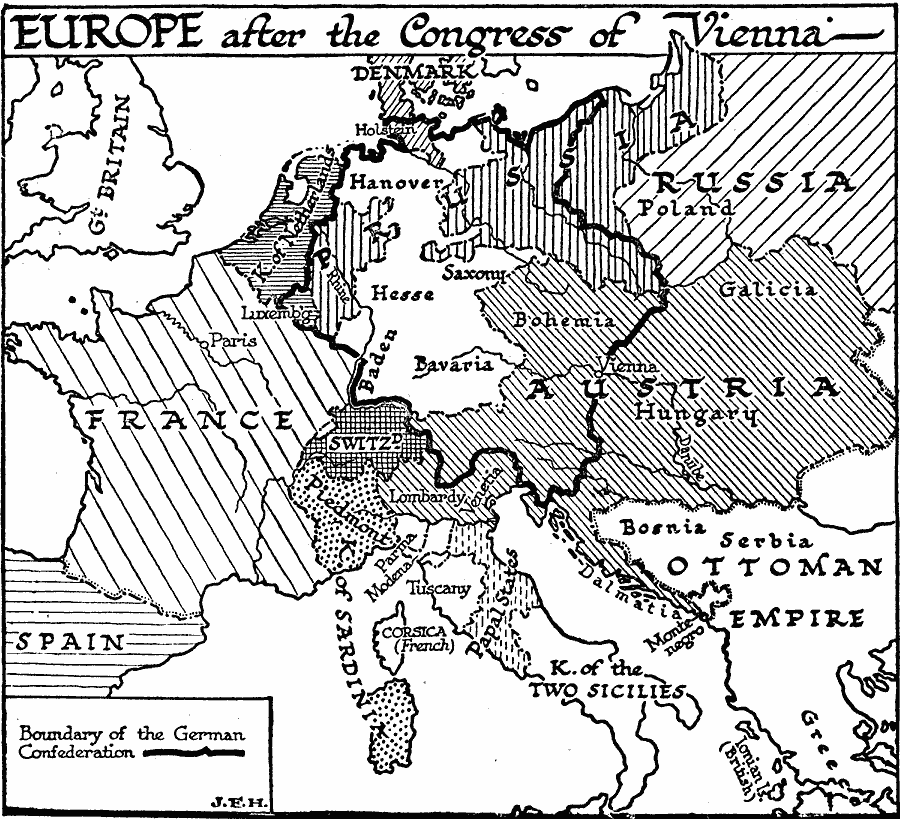
-Which territories did Prussia control in 1815, after the Congress of Vienna?
-Was there any freedom of expression in the German states? Why?
-What was the Zollverein? Did it have any precedent? Why do you think that Austria wasn't allowed to participate by Prussia?
-Which consequences did Metternich's resignation have in 1848?
-What did the Frankfurt Parliament consist of? Did it have any success? Why?
-What was the main aim of the Erfurt Union? Did it have any success?
-What happened in Prussia during 1860-62?
-Were Schleswig and Holstein important in the relationship between Prussia and Austria? Why?
-Which nation added these Danish duchies finally? When were these territories incorporated? (look at the map)
-In 1867 the German states were divided into tho main areas of influence. Which?
-Read the information about the Hohenzollern crisis. Do you think that Bismark acted in a cunning way with regard to this issue? Why?
-If I say that Bismark promoted the nationalist feeling in 1870... what do you understand?
-Which were the last territories to be incorporated to the German Empire (Second Reich) led by Prussia? When were these added?
-When was the Franco-Prussian war fought? How did it end? Which territories were given to the winner?

domingo, 26 de febrero de 2012

The revolutionary 19th century


Revolutionary Europe (1820-1848)

The Congress System broke up because France and Britain were in total disagreement with Russia, Austria and Prussia. After 1815 the great powers never met again.
Nationalism, liberalism and socialism became the major influences which help us to understand the revolutionary processes along the period which started in 1820.

Liberal and nationalist revolutions of 1820
In 1820 the first liberal revolution broke out in Spain. The liberals rebelled, under the initiative of a general called Rafael Riego, and managed to force the absolute king, Fernando VII, who had rejected the liberal constitution which had been previously passed in 1812, to accept the popular sovereignty which was represented by this former legal document. For three years the liberals governed Spain, until French troops intervened militarly in 1823 making the revolution to fail. 
                                               Rafael Riego, a liberal general
Shortly after the Spanish revolution, a liberal revolution in Portugal succeeded and a constitutional government was created. This wouldn't have been possible without an army the British sent in order to make sure that the revolt had success.
In Latin America the subjects of the kings of Spain and Portugal rebelled in order to obtain their independence. Spanish colonies were lost in Latin America, with the exception of Cuba and Puerto Rico.
The members of the Holy Alliance tried to intervene but they met the hostility by the British and the USA president, James Monroe, who declared, in his famous Doctrine of 1823, that any interference by European powers in the affairs of the American continent would be regarded "as the manifestation of an unfriendly disposition to the United States"; in other words, an act of war.     
The last revolution of the decade was the Greek. These people rebelled against the Ottoman Turks. For several years the Greeks had been fighting for their independence from the Ottoman Empire, and finally they obtained it in 1827, thanks to the support of different nations: France, Britain and Russia. In 1832 the European major nations recognized Greece as an independent sovereign state.
                                                                   Siege of the city Messolonghi, symbol of the Greek resistance
Revolutions of 1830
In France the population revolted against the absolute Bourbon monarch, Charles X who had published four ordinances dissolving the Chamber of Deputies, suspended freedom of the press, modified the electoral laws so that three-fourths of the electorate lost their votes, and called for new elections to the Chamber in September. Strikes and protests were followed by armed confrontations. The royal forces were unable to contain the insurrection and, after three days of fighting (July 27–29) Charles X was replaced by another king, Louis-Philippe d'Orléans, who had fought for the French Republic in 1792.
The French example was followed in many parts of Europe in the same year but most liberals throughout Europe were disappointed in their expectations of a radical, social change since the other revolts were supressed harshly.
In Poland, people revolted against the Russian Tsar, but their revolt was cruelly suppressed and Poland was incorporated into the Russian Empire.
Belgium declared its independence from the Netherlands, and it was recognized in 1831 as an independent nation.
The Italian and German nationalist and liberal revolts were cruelly ended.

Revolutions of 1848
This year was known as the Spring of Nations or the Year of the Revolution.
The period of unrest began in France and then, further propelled by the French Revolution of 1848, soon spread to the rest of Europe.
In Paris middle class elements demanding the vote were joined by workers demanding an end to their explotation. King Louis Philippe fled into the exile and his constitutional monarchy was substituted by the French Second Republic. This government was headed by Louis-Napoleon who, after only four years, returned France to a monarchy with the establishment of the Second French Empire in 1852.
The French was the only revolution in 1848 which was successful.
                                                      Le Cri du Peuple (comic by French artist Tardi about this revolution)

Other revolutions: 
a) Liberal (Vienna)
b) Nationalist (Hungary, Bohemia, North of Italy, German states)

The years 1815 to 1848 have often been called "the years of Metternich". Klemens von Metternich was the Austrian chancellor at this period and he was, without doubt, the greatest statesman in Europe. His ambition had been to destroy all traces of revolutionary change in Europe introduced since 1789. He was the arch-conservative who was violently opposed to any kind of reform and who succeeded in imposing his ideas on the rest of Europe, helped by the Holy Alliance.
He realised that if the liberal and nationalist demands were met, and the people of Europe were given the chance to freely choose the country in which they lived and the type of government that ruled them, then the Austrian Empire was finished. Until 1848, he had largely succeeded, but, in that year, when Hungary had risen in revolt and Austrian students had demonstrated in the streets of Vienna demanding "Down with Metternich!", the emperor dismissed him.


Activities:

1) Why do you think that France crushed the first Spanish liberal revolution in 1823?

2) Comment on the following quote by the USA President, James Monroe:
The American continents ... are henceforth not to be considered as subjects for future colonization by any European powers.

3) Comment on the following quote by Von Metternich:
Italy is only a geographical expression

4) Why did the French, who already had a constitutional monarchy, rebel, in 1848, against their monarch, who, besides, had defended the revolutionary principles actively in 1792?

Extra, voluntary task:

1) Write a composition (250 words) on the Latin American Revolutions and the role Simon Bolivar adopted in these.

martes, 14 de febrero de 2012

Let's go back to the past: The European Restoration

I. The Congress of Vienna (1814-15)

After Napoleon's abdication in April 1814, representatives of all the states of Europe met in Vienna in order to decide what to do now that the Napoleonic threat had disappeared.
They had three priorities:

-To reduce the size of France to its frontiers before Napoleon's invasion.
-To ensure that France could never again be a threat to the rest of Europe.
-To recompense those countries that had been “anti-Napoleon” and punish those that had been “pro-Napoleon”.

The attendants to this meeting in Vienna were:

a) Austria, Prussia, Russia and Britain (the most important)
b) France, Spain, Portugal and Sweden
c) Bavaria, Hanover, Denmark and Savoy (minor states)

The map of Europe was modified after the Congress in this way (click on these words to enlarge the map below):


There is another map (in colour and clearer) of the territorial distribution after Congress of Vienna on the following link you can also use.

Major failings of the Congress of Vienna were:

a) The redrawing of the map of Europe took no account of the wishes of the ordinary people, with regard to the nationalist feeling which had appeared during the Napoleonic military campaigns and had been fatal to him. Millions of people in Europe refused to accept the imposition of foreign rulers and, as a result, nationalist revolutions broke out in many regions after 1820.
b) After the dismantling of Napoleon's empire, Russia, Austria and Prussia wanted to reinstall monarchies of the Ancien Régime. This led to more revolts and revolutions since Napoleon had introduced liberal constitutions which made a profound impact on the people who lived in the regions the French Emperor had conquered.

II. The Holly Alliance

It was a coalition of different states which was created in 1815 and whose members were Russia, Austria and Prussia .The monarchs of these three nations wanted to install the Christian values of charity and peace in European political life, but in practice what they were chasing was to band together in order to prevent revolutionary influence (especially from the French Revolution) from entering their territories. Except for Great Britain, the Vatican and the Ottoman Empire, all other European nations joined.

Activities:
  1. Which type of government did the founders of the Holly Alliance have? Why didn't Great Britain join forces with these nations?
  2. Remember what we have seen in class about liberalism. Describe the political and economical features this term had at the time you are studying. Did the Enlightenment have any influence on liberalism? Why? 
     
  3. Compare the 1812 map and the map for the period after the Congress of Vienna. Which changes can you observe? 
     
  4. What's the model for the liberal constitutions Napoleon introduced? 
     
  5. Comment on the following sentence from a History textbook :
    The European Restoration meant an ideological conflict whose consequences echoed throughout the nineteenth century (...)”.
           Focus on these concepts: European Restoration, ideological conflict and consequences

martes, 7 de febrero de 2012

Extra sources about Napoleon

Napoleon (2002)


French-German-British mini-series about Napoleon's figure.

Master and Commander: The Far Side of the World (2003)


Film based on author Patrick O'Brian's series of naval books whose action is set during the Napoleonic Wars, at the beginning of the 19th century. A good adventure film as well as a historical drama which was nominated to 10 Oscars.

War and Peace (1956)


Classical drama film based on Leo Tolstoy famous novel which illustrates the war between the French and the Russian Empires.

Barry Lyndon (1975)


Film which tell us about the adventures and misadventures of a member of the minor, landed aristocracy of Ireland who wants to climb the social ladder and reach a higher position by means of enrolling in the British army. Subsequently this fact will lead him to participate in the Napoleonic Wars. 
The film was produced, written and directed by famous director Stanley Kubrick and it is considered one of his finest works.

The Duellists (1977)


Historical drama film which is set during the Napoleonic Wars and whose plot is about two French Hussar officers's feud, whose cause is a misundertanding between both duellists, is  over fifteen(!) years. It was the first film Ridley Scott directed. As an anecdote I'd say that this film contains real fencing scenes, something which is not usual in most later films.

sábado, 28 de enero de 2012

Ideologies in the 18th and 19th centuries (PDF)

If you click on the following link you'll be able to download the pdf we are commenting in class on these days.

Rowing with the Wind (Remando al viento), by Gonzalo Suárez (1987)


Mary Shelley, Percy Bysshe Shelley, Lord Byron, John Polidori and, of course, "the Monster", in a dramatic film by Gonzalo Suárez which won seven Goya Awards and is representative of the spirit of Romanticism.
(Sorry but there is no English trailer in Youtube...)

Napoleon, that short loony


Napoleon Bonaparte was a military and political leader of France and Emperor of the French as Napoleon I, whose actions affected European politics in the early 19th century.
Napoleon Bonaparte was born on the island of Corsica in 1769. He was the son of a noble. In 1785, at the age of 16, Napoleon became second lieutenant in the artillery.
Napoleon became sympathetic to the Revolution in 1789. In the Battle of Toulon in 1793, Napoleon led a victorious attack on a Royalist fort and was then promoted to Brigadier General. Napoleon gained more attention in 1795 when he put down a pro- royalist coup in Paris. He was promoted to Major General.
In 1796 he was put in charge of the French army fighting the Austrians, who, being pro-absolute monarchy, were anti-revolutionaries, in Italy. Napoleon and his army won several great victories over the Austrians and Italians. Between 1798 and 1799 Napoleon’s plans to attack the British went badly wrong. His army was ravaged by plague and sickness, and Nelson’s British Navy destroyed many of Napoleon’s own ships. Still, Napoleon seized Malta and had several victories in Egypt during the expedition.
Napoleon returned to Paris in August 1799, after hearing of the military crisis facing France and on November 11th 1799, Napoleon seized control of France in the ‘coup d’état’ (or Coup de Brumaire). Following the Coup, a new constitution was introduced, and Napoleon was made First Consul of France. Then, on December 2nd, 1804, in the presence of the Pope, Napoleon crowned himself Emperor.

Napoleon and his influence over Europe

Napoleon conquered most of continental Europe. As he conquered other European nations, he helped to spread some of the French Revolution ideas and put his relatives in control. Napoleon named himself king of Italy while his brothers became kings in Spain (Joseph Bonaparte), Holland and Westphalia (now part of Germany).
Unfortunately for him, his invasion of Spain was a disaster, which persuaded the Austrians to start a new war against the French. In 1812, his campaign against the Russians had the same result. Finally, the allied nations of Europe defeated Napoleon in 1813 and in 1815 (Waterloo). He was forced to exile to an island called St. Helena, where he died in 1821.
Thanks to this character, the revolutionary, liberal ideas whose origin is French, spread across Europe where they mixed with another new concept, nationalism.

Napoleon and his work in France

Napoleon became Emperor of France, and could not be removed from power. There were two National Assemblies, with members chosen by Napoleon from candidates elected by the people. All men could vote, but after 1804, there were no elections. All laws were made by the Assemblies.
France under Napoleon sometimes seemed similar to France under King Louis. The Prison and Courts system was ‘officially’ different, in that you could no longer be put in prison without charge and everyone was equal in the courts, nobles did not have special rights anymore, but even in
Napoleon’s rule there were restrictions. He had a secret police force, which from 1810 could arrest people without trial. Napoleon, like King Louis, and unlike the Revolution, tried to censor and control the newspapers, and free speech was not allowed in France or the French Empire.
During the Revolution, the land owned by the Catholic Church was sold off and any religion was permitted (only Catholicism was practised in the ‘Ancien Regime’). In 1802, Napoleon made an agreement with the Pope called the Concordat in which the Pope agreed that the Church would not get its land back and in return, Catholicism was accepted as the religion of the majority. As well as this, it was agreed that Bishops were to be chosen by Napoleon, and agreed by the Pope. This meant that the government now had greater control over the Church.
In 1804 the Napoleonic Code was introduced. It had a set of clear laws, applicable to all members of French Society. The Code was also introduced into other parts of Europe conquered by Napoleon, like Italy, Spain and some parts of Germany.

The Code Napoleon (1804)

The Code stated that:
All people were declared equal before the law.
There were no longer any special privileges for
Nobles, Churchmen or rich people
Feudal rights were ended.
Trial by Jury was guaranteed.
Religious Freedom was guaranteed.
Wives were not allowed to sell or give away
property.
A wife could only own property with her
husband’s consent in writing.

 Activities

0) Comment on these Napoleon's quotes:

Frenchmen, without a doubt, you will see in what I did that I am a soldier who supports liberty and am a citizen who is devoted to the Republic.(From a translation of the official version of the coup)

It is not what is true that counts, but what people think is true.”

1) Read the extract from the Napoleonic Code and answer:

Are the contents of this code original (=new)? Why?

2) Explain this quote by Napoleon:

The People must have religion, and religion must be in the hands of the government.”

3) Look at the map below and answer the following questions:

a) Why do you think other European nations decided to start a war against France before Napoleon's “coup d'état”?
b) Why did Napoleon decide to continue the war in Europe?
c) Which nations were the most important enemies of France? Why?
d) Why do you think the British and the French fought in Egypt?
e) Is the date for this map relevant?
f) Look for information about the Confederation of the Rhine. How was it founded? Which Baltic nation had interest on this area? Which opinion did this nation have about the French influence in central Europe?
g) Look for information about the Grand Duchy of Warsaw and answer this question: How did Napoleon manage to control this Duchy?
h) The nation we know nowadays as Italy was divided into different states before the Napoleonic era. What did Napoleon do in the Italian peninsula? Which Italian territories belong to France? Over which territories did Napoleon have indirect control? Why do you think the Italians fought the French? (in order to answer this last question you'll have to investigate). 
 
4) Voluntary task: Look for information about Spain at the time. Write a 300 words composition about the Spanish participation in Napoleon's affairs.

martes, 10 de enero de 2012

Primary sources about socialism and other ideologies which appeared during the Industrial Revolution

“All parties without exception, when they seek for power, are varieties of absolutism” (Proudhon)

"Let the ruling classes tremble at a communist revolution. The proletarians have nothing to lose but their chains. They have a world to win. Workingmen of all countries, unite! (...)  Revolutions are the locomotives of history. (...)To my mind, the so-called ‘socialist society’ is not anything immutable. Like all other social formations, it should be conceived in a state of constant change. It’s basic difference from the present order consists naturally in production organized on the basis of common ownership by the nation of all means of production". (K.Marx)

We perform the duties of freemen; we must have the privileges of freemen. 
Consequently, firstly we demand universal suffrage. The suffrage to be exempt from the corruption of the wealthy, and the violence of the powerful, must be secret.This demand should be completed with the ballot.
We also consider that, to public safety as well as public confidence, frequent elections are essential, so that we demand annual parliaments. (Adapted from the People's Charter, 1838)

I know that society may be formed so as to exist without crime, without poverty, with health greatly improved, with little, if any misery, and with intelligence and happiness; and the only obstacle we have nowadays to reach this state of society is ignorance. (Robert Owen)

As the Liberty lads o'er the sea
Bought their freedom, and cheaply, with blood,
So we, boys, we
Will die fighting, or live free,
And down with all kings but King Ludd! (Lord Byron)


“The great are only great because we are on our knees. Let us rise!”
(Max Stierner)

“The oppressed are allowed once every few years to decide which particular representatives of the oppressing class are to represent and repress them.”
(K.Marx)

“Religion is the opium of the masses.”
(K. Marx)

“The extension of women's rights is the basic principle of all social progress.”
(Charles Fourier)

“Revolutions are the produce of passion, not of sober and tranquil reason.” (William Godwin)


martes, 20 de diciembre de 2011

Modern Times (1936), by Charles Chaplin

Quality of these clips from Youtube is low, so I'd try to watch the film online or, simply, download it.


Don't forget to make a list of those topics from the Industrial Revolution you have learned in class which appear in the film. 
Finally, write a composition (only 250 words) about the comparison which can be made between those topics and the situation resulting from the Depression Chaplin lived . Some ideas you can use are: What did Chaplin think about industrialisation? Which social class is Chaplin's favourite one according to the film? Can you conceive of an ideological reason for Chaplin to defend this social class? Is the situation in the post-Depression USA similar to the one you have studied for England in the 18th century? What's your opinion about the film? Give arguments.
You'll have to hand in this composition on the first Friday after Christmas holidays.

domingo, 11 de diciembre de 2011

Ideologies and the Industrial Revolution

Introduction

During the 1800s, worker disenchantment grew as living conditions deteriorated. As the Industrial Revolution progressed, the factory owners accumulated great wealth while the working classes retained none.
While industrialists did not want any change in the status quo, workers and intellectuals alike both wanted a complete restructuring of society.

Although Britain had become a constitutional monarchy a century earlier, the vast majority of the population could not vote. As industrial strength grew along with a middle class, electoral reform was a necessity to balance the new society's power structure.
Before 1832, only 6% of the male population could vote - represented by aristocrats who owned large plots of land in the countryside and other properties.
By 1832, the middle class factory owners wanted political power to match their new-found economic punch - this resulted in the Reform Bill of 1832 which enable 20% of the male population to vote.
The middle-class became more or less satisfied, but workers were still not represented by the British electoral system.

Socialism is born!!: The Utopian Socialists

The first self-proclaimed socialists, St-Simon, Owen, and Fourier believed in a gentle socialism created by persuading factory owners to give up profits in exchange for more human conditions for workers.

St-Simon (1760-1825)
French-born aristocrat, renounced his title and supported the French Revolution. As one of the first socialists, he supported public control of means of production.

Charles Fourier (1772-1837)
French-born member of the bourgeoisie. Fourier wished to establish "Phalanxes," self-sufficient communities where people would live according to their natural inclinations. He rejected, however, industrialization and instead imagined a community based on agriculture and a return to the "cottage-industry" of pre-industrial times.

Robert Owen (1771-1858)
English-born entrepreneur turned socialist. He became immensely successful in the textile industry, amassing a large fortune . Called the "Father of British Socialism," Owen first established a community in New Lanark, Scotland, where he modernized the system of production and provided excellent working conditions. He established funded-schools, non-profit stores, and other social services, while the factories in the town managed to increase their profits.
Spurred on by this success, Owen's next project was to create a self-sustaining town; thus was born New Harmony. The venture bankrupted Owen, and the town collapsed; its inhabitants were not necessarily as embracing of Owen's communism as he was.

Aerialview of New Lanark today


Karl Marx (a scientific socialist)

Karl Marx (1818-1883) was a German-born academic and political philosopher. In 1843 Marx went to Paris (after a newspaper he published was banned) where he befriended Friedrich Engels. Marx embraced socialism, and the two published the Communist Manifesto in 1848, which became the definitive text for socialism and communism. In 1867, Marx produced Das Kapital, which linked economics to history.


Marx outlined his belief that all aspects of an individual's life are determined by that individual's relationship to the means of production.
Classes were established by the various degrees of connection to the means of production. In this way, governing classes always owned the means of production while the least powerful working class (or proletariat, in Marx's words) did not.
Marx believed that the only changes in this power structure would occur through revolution. This theory is known as the Marxist Dialectic.

According to the Marxist Dialectic at the beginning exists the group in control, or the thesis - the existing society, with its power vested in a certain class (in Marx terms the owners of the means of production).
Against the thesis is the antithesis - the group that wants social change and does not have power.
When the tension has grown sufficient, a revolution occurs. In Marx's theory, revolution was the only method to provoke real social change.
The result of the revolution is the synthesis - a combination between the thesis and the antithesis. This, in turn, becomes the new thesis, and remains so until a new antithesis sparks another revolution.
Eventually, the result of this was to be socialism - a utopian society based on equality between individuals with all having equal access to the means of production.

Luddism

In the first few months of 1811, manufacturers in the city of Nottingham began to receive threatening letters from the mysterious "General Ned Ludd and the Army of Redressers." Workers of the area, angry at employers who were reducing wages and even replacing experienced employees with unskilled (and therefore less expensive) laborers, began to revolt, breaking into factories and destroying hundreds of water frames in the space of a few weeks.
The concept became known as Luddism, and over the next year the movement spread throughout the industrial centres of England. Damages inflicted were generally restricted to the destruction of factories and mills, but occasionally extended to violence against people, including the killing of William Horsfall, the owner of a large mill in the area of Yorkshire (Luddites - the machine breakers).


The government's reaction to Luddism was quick and crushing. A reward of £50 was offered to anyone who could provide information about the Luddites, and in February of 1812 a law was passed making the destruction of machines a capital offence. Twelve-thousand troops were sent to protect factories in Nottingham and other regions where Luddites were active. At least 23 people were executed for attacks on mills in the summer of 1812, and many others were deported to Australia. Although some violence continued, the Luddite movement in England had disintegrated by 1817.

Chartism

The insubordination of the English workingmen reached its peak in the mid- nineteenth century with Chartism, an ideology that called for political reform in the country. Its name was based on the People's Charter, a document written in 1838 by William Lovett and other radicals of the London Working Men's Association.
The Charter called for several changes to the Parliamentary system:

-Universal Male Suffrage
-Annual Parliaments (against corruption)
-Vote by ballot
-Abolition of the property qualification for MPs
-Payment of MPs
-Equal electoral districts.

Chartist demonstration at Kennington, in 1848

Chartism rapidly gained support among the poorer classes and in Northen England, where economic depression was common. However, the movement soon lost its momentum when its leaders became divided over how its demands were to be enforced. A petition to Parliament was rejected in July of 1839, and most of the movement's leaders were arrested by the end of the year after the November clash between Chartists and the military at Newport, Wales.
Finally people lost interest, appeased by better economic conditions, and a revival of trade unionism, and the movement faded away. Decades later, in 1884, the majority of males were finally granted the right to vote.

Anarchism

The modern anarchistic philosophy was developed by William Godwin in his book Enquiry Concerning Political Justice in 1793. Anarchism has some basic premises:

(1) Man is essentially a benign creature. He was born good, or with the potentiality for goodness, but has been corrupted by the habits and institutions of authority. Religion, education, politics, and economic life have all served to pervert this natural goodness.

(2) Man is a social animal, and men reach their fulfillment when voluntarily and spontaneously cooperating with one another. Society is natural, the state is not; and the quest for the communal life is instinctive to all men.

(3) Prevailing institutions of society - particularly private property and the state - are artificial agencies through which men exploit and corrupt each other. Authority in any form, even democratic government or socialist economy, atrophies the individual.

(4) Social change must be spontaneous, direct and mass-based. Political parties, trade unions are themselves elements of authority. While pursuing reform or even revolution, they are so constituted as ultimately to replace one evil with another of a similar sort. Significant change, then, must express the natural sentiments of a mass of autonomous individuals acting without outside direction.

(5) Industrial civilization, no matter what the form of ownership of the means of production, perverts the human spirit. Machines master men, narrowing their personalities and blocking creativity.

Main types of Anarchism: 

a) Individualistic Anarchism:
Advocated by Pierre Joseph Proudhon, which argues that private property should exist but should also be totally free from any state interference or restrictions.

b) Communistic Anarchism:
Rejects the principle of private property and seeks instead the common ownership of all means of production. The forced collectivization which occurs under Marxism is also rejected in favor of voluntary cooperation. Socialistic or Communistic Anarchists believe that the government serves not the people, but instead the interests of capitalist corporations. Thus, both corporations and governments are regarded as unacceptable forms of coercive authority.

c) Terroristic Anarchism:
Following the lead of Max Stirner, seeks the assassination of political leaders and other violent acts designed to undermine structures of power and authority.

Questions:

-Which two main problems did the working class have by 1832?
-Why did workers and intellectuals want "a complete restructuring of society"?
-Which aim did the first socialists share?
-Define "means of production" and then give examples of means of production you could find in a 19th century mill.
-What do you understand in this sentence?: "He supported public control of means of production".
-Which impact did the first socialists have?
-Why do you think that first socialists are also known as "Utopian"? Look up this word and then take into consideration your answer for the previous question.
-Which main ideas are the basics of Marx's theory?
-According to Marx, what's the thesis at his time? And the antithesis? And the synthesis?
-Which word, which was created by Marx, have you seen in class to describe workers? 
-Did luddites have any success in their protests?
-Which main claim did chartists have?
-Did the chartists have any success in their demands?
-Would an anarchist fight politically to obtain more rights for the workers as the chartists did? Why?
-What would an anarchist think of competition among individuals?
-Is it democracy positive in an anarchist's opinion? Why?
-Did the Industrial Revolution mean progress for an anarchist? Why?
-Did all anarchists share the same ideas about private property?